
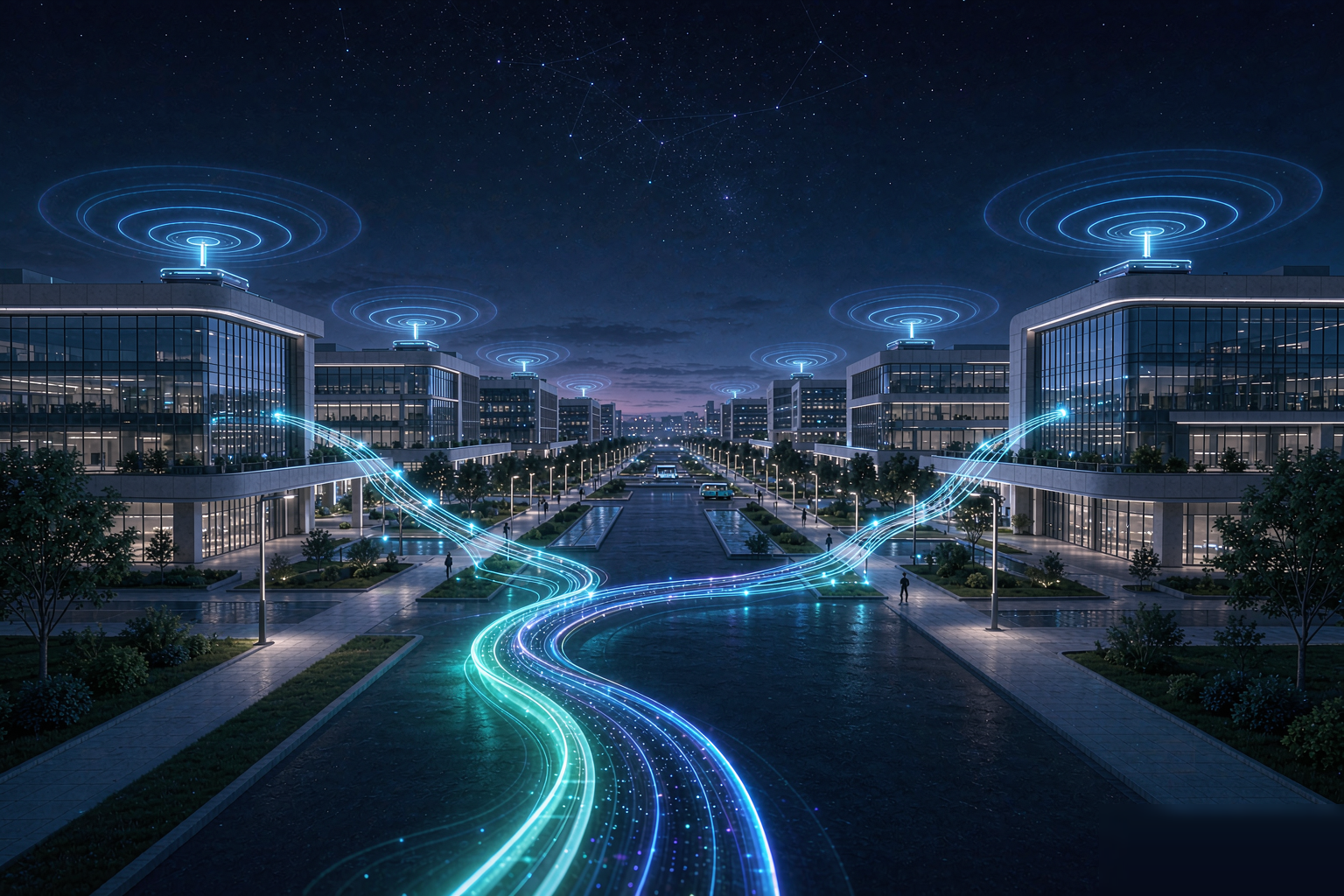
When the campus network engineering team at Northeastern University Qinhuangdao surveyed its 14,000 students and faculty in late 2024, they found a network that had aged out of usefulness: wireless coverage hovering around 20 percent, dormitories without Wi-Fi at all, dropped Zoom calls during exam weeks, and three parallel authentication realms that required separate logins for dorms, classrooms, and offices. Within twelve months, a joint team from Ruijie Networks and the university IT department completed one of the most ambitious campus overhauls in Chinese higher education: a 10 Gbps all-optical backbone, fiber-to-room coverage in every teaching block, 2.5 Gbps uplinks to 5,400+ dormitory Wi-Fi 7 APs, and a single-sign-on platform that lets a student roam transparently from a classroom to a cafeteria to a dormitory bed. The network now supports 60,000 concurrent devices — a 20x download-speed improvement — and is engineered for the next five years of digital-campus innovation.
That Northeastern Qinhuangdao project is not an isolated story. It is one of dozens of full-campus F5G-A + Wi-Fi 7 buildouts that defined 2026 in Chinese higher education. H3C deployed 1,846 Wi-Fi 7 APs and 428 optical network units at Ma'anshan Technical College. Huawei's F5G-A campus at Fuyang Normal University won the 2026 F5G-A Industry Alliance's Higher Education Best Practice award, with 12.5 Gbit/s per-room throughput. And ZTE's 50G-PON rollout at Southeast University's Sipailou Campus delivered 10 Gbps bidirectional speeds with 0.1 ms latency. Together, these deployments anchor a global campus network market that Business Research Insights sizes at USD 12.21 billion in 2026, growing to USD 30.53 billion by 2035 at a 10.5% CAGR.
1. The 2026 Inflection Point: Why All-Optical + Wi-Fi 7 Is Converging on Campus
Three forces are aligning to make 2026 the year the legacy three-tier campus network (core-aggregation-access over copper) became obsolete. First, the F5G-A standard, finalized by the ITU-T in 2024, codifies XGS-PON Pro and 50G-PON as the wired backbone for Wi-Fi 7. Second, the Wi-Fi 7 (802.11be) standard ratified in early 2024 introduced 320 MHz channels, 4096-QAM, and Multi-Link Operation — features that, in practice, demand fiber backhaul to avoid bottlenecking. Third, China's digital education policy — and equivalent U.S. E-Rate and EU Digital Education Action Plan initiatives — has turned campus network upgrades into a national infrastructure priority, with the F5G-A Industry Alliance recognizing "F5G-A 10G Optical Network Education Best Practice" awards in 2026 for Anhui Vocational & Technical College (Fanchang campus), Fuyang Normal University, and other flagship sites.
The convergence is visible in the numbers. According to Business Research Insights, 56 percent of campuses are now upgrading to high-speed wireless infrastructure, while 47 percent are shifting to centralized SDN control platforms. The Digital Campus Construction market — which counts the infrastructure and software layers together — reached USD 31.99 billion in 2026 and is projected to reach USD 62.03 billion by 2032 at an 11.78% CAGR. North America leads with a 38-46% share of campus network spend, but Asia-Pacific is the fastest-growing region (30-34% share, CAGR above 9.8%) — and within Asia-Pacific, Chinese F5G-A campus buildouts are the dominant share-taker.
2026 Campus Network Market at a Glance
- Global campus network market: USD 12.21 B in 2026 → USD 30.53 B by 2035 (CAGR 10.5%, Business Research Insights).
- Global digital campus construction: USD 31.99 B in 2026 → USD 62.03 B by 2032 (CAGR 11.78%, PW Consulting).
- K-12 IT infrastructure spending: USD 68.4 B in 2026 → USD 144.92 B by 2035 (CAGR 8.7%, MarkWide Research); network equipment + cloud deployment dominate addressable spend.
- Connected education (platforms + services):USD 552.89 B in 2026, projected USD 1.54 trillion by 2032 (CAGR 18.0%, PW Consulting).
- Regional split: North America 38-46%, Asia Pacific 30-34% and growing fastest, Europe 28%.
- Adoption signals: 56% of campuses upgrading wireless; 47% shifting to SDN / cloud-managed LAN; 32% reporting cyber-threat exposure as a procurement driver.
2. Wi-Fi 7 (802.11be): The Wireless Half of the Equation
Wi-Fi 7 is not a marginal speed bump. Four standard features redefine what a campus access point can deliver, and each one changes procurement math for 2026-2027 deployments:
- 320 MHz channel bandwidth.Doubling the widest Wi-Fi 6 channel allows single-AP throughput above 10 Gbps in clean spectrum — and explains why Ruijie's RG-AP9751-R high-density AP and H3C's Wi-Fi 7 BA 7 indoor AP can each sustain 12+ Gbps aggregate rates.
- 4096-QAM modulation. 20 percent higher spectral efficiency than 1024-QAM in Wi-Fi 6/6E, with a noise floor roughly 3 dB tighter. Critical in lecture halls and libraries where every dB of link budget matters.
- Multi-Link Operation (MLO). A single client can transmit across 2.4 GHz + 5 GHz + 6 GHz simultaneously, effectively tripling real-world throughput and cutting tail latency below 2 ms — the threshold for AR/VR teaching experiences and remote-laboratory applications.
- Enhanced OFDMA + spatial streams.Up to 16 spatial streams and refined OFDMA scheduling allow a single radio to serve 100+ concurrent terminals. Ruijie's RG-AP9751-R has been publicly demonstrated with 115 concurrent Wi-Fi 7 clients streaming 1080p video with no frame drop.
Importantly, Wi-Fi 7 only delivers these capabilities when the wired uplink is fast enough. A Wi-Fi 7 AP capable of 10 Gbps wireless, attached to a 1 Gbps Ethernet uplink, would be bottleneck-limited to one-tenth of its rated throughput. That is why every 2026 campus Wi-Fi 7 deployment has been paired with a multi-gig or all-optical wired backbone — F5G-A, XGS-PON Pro, 50G-PON, or Ruijie's simplified Ethernet color optical architecture.
3. Reference Architecture: Ruijie at Northeastern University Qinhuangdao
The Northeastern University Qinhuangdao campus case study, originally published by Ruijie Networks and the university IT team, illustrates the playbook that Chinese universities are now using as a template. The university adopted four guiding objectives: full-scenario wireless coverage, technology foresight with Wi-Fi 7 + fiber-to-room, unified management with one account for all scenarios, and open multi-ISP access with user choice of carrier.
Ruijie's solution used "all-optical networking plus mixed-cable PoE" as the core technical path, then differentiated deployment across five campus zones:
| Zone | Architecture | Throughput |
|---|---|---|
| Core egress | Dual-redundant high-performance core switches; 300,000 concurrent IPv4/IPv6 sessions | 10G backbone |
| Teaching area | 16-port classroom switches with 10G uplinks + Wi-Fi 7 APs per classroom | Up to 12 Gbps per AP |
| Dormitories | One Wi-Fi 7 AP per room with 2.5G uplink; inter-room isolation | 2.5G per room |
| Offices | All-optical wireless AP with 1:20 AP-to-endpoint ratio; VLAN segmentation | 2.5G wired + Wi-Fi 7 |
| Outdoor & special zones | Industrial-grade outdoor Wi-Fi 7 APs at sports fields, plazas, and main roads | IP68-rated, -40°C to +65°C |
The deployment delivered six measurable upgrades: 100 percent wireless coverage with seamless roaming across 1.4 million square meters; a network capable of carrying 60,000 concurrent devices; a 20x download-speed improvement; one unified authentication system that replaces the legacy split between dorm, campus, and office networks; open multi-ISP access with user choice of carrier and unified audit; and MLPS Level 3 cybersecurity certification with real-name authentication, full-traffic audit, and threat-intelligence integration.
4. The Competitive Landscape: Ruijie vs H3C vs Huawei vs ZTE
The all-optical + Wi-Fi 7 campus opportunity has drawn a tight field of four major Chinese vendors, each with a distinct technical and commercial positioning. Procurement teams in 2026 are evaluating them on five dimensions: F5G-A standards contribution, Wi-Fi 7 portfolio breadth, unified management capability, multi-ISP openness, and reference deployments at scale.
| Vendor | Signature Strength | 2026 Reference Campus |
|---|---|---|
| Ruijie | EDN 2.0 experience-driven networking; color optical with single-fiber 16-wavelength 10G-to-room; 18.67 Gbps outdoor AP | Northeastern University Qinhuangdao |
| H3C | BRAS-based central policy + BRAS access; mature campus install base; end-to-end stack including cloud desktop | Ma'anshan Technical College (1,846 Wi-Fi 7 APs + 428 ONUs) |
| Huawei | F5G-A standards leadership; XGS-PON Pro + Wi-Fi 7 optical AP at 12.5 Gbit/s per room; iMaster NCE-Campus | Fuyang Normal University; Anhui Vocational Fanchang campus |
| ZTE | 50G-PON with AI-assisted roaming and RF tuning; FTTR-B fiber-to-room for business; +25% throughput vs traditional | Southeast University Sipailou Campus (10 Gbps, 0.1 ms) |
For global buyers, the H3C-Unisplendour and Huawei portfolios are constrained by export-control and ecosystem compatibility considerations, which is one reason Ruijie and ZTE have become the default alternatives in Southeast Asia, the Middle East, Africa, and Latin America. Ruijie's 2026 product launches — particularly the RG-AP6981 outdoor Wi-Fi 7 AP, the RG-AP1920-X spotlight-style AP that won a 2026 iF Design Award, and the RG-AP9751-R high-density indoor AP — have meaningfully closed the feature gap with global Tier-1 vendors.
5. Ruijie's 2026 Portfolio: Five Products Shaping the New Campus
Ruijie's H1 2026 product cadence defined the new campus stack and gave Chinese universities a credible alternative to imports. The five product lines worth tracking:
5.1 RG-AP6981 — Industrial-Grade Wi-Fi 7 Outdoor AP
Released in 2026, the RG-AP6981 is the first Ruijie outdoor Wi-Fi 7 AP built for stadium-grade density. It is a hardware-independent tri-radio design with 12 spatial streams; in 5 GHz mode it delivers 12.907 Gbps aggregate, and in 6 GHz mode it reaches 18.67 Gbps. IP68 protection, -40°C to +65°C wide-temperature operation, 10 kV common-mode surge protection, and EN300 0019 Class C corrosion resistance make it suitable for sports fields, coastal campuses, and mining sites. Critically, it ships with two 10 Gbps SFP+ ports for Ruijie's simplified Ethernet color optical architecture — one fiber pair replaces legacy copper runs and powers the AP via PoE++.
5.2 RG-AP1920-X — Spotlight-Style Wi-Fi 7 Indoor AP
The 2026 iF Design Award winner. The RG-AP1920-X solves a long-standing aesthetic problem: APs installed in ceilings or air ducts lose 30-40% of their signal because of physical occlusion. Ruijie's ceiling-spotlight form factor, with concealed latches and a separate mounting bracket, delivers 3.57 Gbps aggregate throughput while blending into high-end hotel, banquet hall, and executive-boardroom ceilings.
5.3 RG-AP9751-R — High-Density Indoor Wi-Fi 7 AP
Publicly demonstrated in 2026 with 115 concurrent Wi-Fi 7 terminals all streaming 1080p video without frame drop. The RG-AP9751-R is the AP of choice for lecture halls, library reading rooms, and stadium concourses — the same high-density scenario that drives Ruijie's "Bedrock Wireless" solution architecture.
5.4 Ruijie Simplified Ethernet Color Optical Architecture
Announced in Ruijie's 2026 H1 report, the color optical architecture now ships in two modes: ultra-aggregated mode (single fiber, 16 wavelengths, dedicated 10 Gbps per room) and ultra-converged mode (lower-cost, optical-electrical hybrid deployment). The architecture is positioned as the on-ramp to AI-class bandwidth — useful for high-performance computing teaching clusters, AI inference classrooms, and 8K video production studios.
5.5 EDN 2.0 — Experience-Driven Networking 2.0
Launched at the April 2026 EBG Global Partner Conference, EDN 2.0 is Ruijie's flagship campus architecture. It reframes network management from device-centric (configuring switches, APs, and firewalls) to experience-centric (navigating user-perceived quality across business, security, and operations). Gartner predicts that by 2027, 90% of enterprises will rely on Real User Monitoring and synthetic monitoring to report digital experience — Ruijie positions EDN 2.0 as the network-level implementation of that trend.
6. Five Strategic Trends That Will Define 2026-2027 Campus Networking
Trend 1 — F5G-A Becomes the Default Backbone for Higher Ed
Every new flagship Chinese university campus in 2026 — Ruijie at Northeastern Qinhuangdao, Huawei at Fuyang Normal, ZTE at Southeast — uses F5G-A as the wired backbone. Expect that pattern to spread to K-12 over 2027 as MLPS Level 3 cybersecurity certification timelines mature.
Trend 2 — AI-Driven Operations Replace Reactive IT
ZTE's AI-assisted roaming, Ruijie's WIS intelligent analysis, and H3C's iMC automation point to a shared direction: networks that diagnose themselves, recommend remediations, and close tickets without human intervention. Expect 30-50% reduction in Tier-1 help-desk load by 2028.
Trend 3 — Wi-Fi 7 Becomes Procurement Default for New Builds
With MLO and 320 MHz channels, Wi-Fi 7 is no longer a premium option. New RFPs in 2026-2027 will specify 802.11be as a baseline, locking out Wi-Fi 6/6E bids even for cost-sensitive deployments.
Trend 4 — Green Campus Networking Is Now a Procurement Criterion
All four vendors now publish EPD (Environmental Product Declaration) documents. Energy-efficient PoE, sleep-mode radios, and fanless AP designs are scoring criteria in 2026 RFPs — a notable shift from the "throughput-only" evaluations of 2020-2024.
Trend 5 — Open Multi-ISP Access Becomes Standard
The Northeastern Qinhuangdao deployment is one of several 2026 projects that explicitly separated the network operator role from the network service provider role — letting students and faculty pick carriers and plans while sharing a common authentication and audit layer. Expect this multi-ISP pattern to spread to corporate and hospitality networks over 2027.
7. Procurement Guide: How JSA Solution Engineers an All-Optical Wi-Fi 7 Campus Bid
For procurement teams building or refreshing a campus network in late 2026 or 2027, JSA Solution recommends an eight-step evaluation:
- Map the campus scenarios. Teaching, dormitory, office, outdoor, library, and laboratory each demand a different radio density, uplink speed, and form factor.
- Confirm the wired backbone. Decide between F5G-A (XGS-PON Pro), 50G-PON, simplified Ethernet color optical, or a hybrid depending on budget and lifecycle planning.
- Audit Wi-Fi 7 portfolio breadth. Indoor high-density AP, panel AP, spotlight AP, outdoor IP68 AP — the vendor should offer all four with consistent firmware and management.
- Verify the unified management platform. Look for AI root-cause analysis, one-click optimization, heat-map visualization, and integrated NAC + WIDS.
- Validate multi-ISP openness. The platform must integrate with at least two ISP billing and authentication systems without proprietary lock-in.
- Require cybersecurity certifications. MLPS Level 3 in China, Common Criteria EAL3+ internationally, ISO/IEC 27001 information security.
- Check sustainability documentation. EPD, energy-efficient PoE, recycled plastic content, end-of-life take-back program.
- Negotiate a 7-year TCO roadmap. Include Wi-Fi 7-to-Wi-Fi 8 migration paths, software subscription model, and managed-service options.
As a value-added distributor for Ruijie Networks, ZTE, H3C, Huawei, Cisco, and complementary brands, JSA Solution helps higher-education and K-12 buyers run an apples-to-apples RFP across all four major all-optical + Wi-Fi 7 vendors. We supply core switches, aggregation switches, color optical line terminals, Wi-Fi 7 indoor/outdoor APs, and turnkey deployment services through certified system integrators in Hong Kong, Singapore, Dubai, and Latin America.
Conclusion
All-optical + Wi-Fi 7 is no longer a future architecture — it is the 2026 default for higher-education campus networks. Ruijie's reference build at Northeastern University Qinhuangdao, H3C's Ma'anshan deployment, Huawei's F5G-A flagship at Fuyang Normal, and ZTE's 50G-PON at Southeast University together define a clear procurement playbook: F5G-A or 50G-PON backbone, color optical to the room, Wi-Fi 7 APs in four form factors, AI-driven unified management, multi-ISP openness, MLPS Level 3 cybersecurity, and a 7-year TCO roadmap that includes Wi-Fi 8 readiness. For higher-education IT leaders, the question in 2026 is not whether to migrate but which vendor ecosystem best fits the institution's risk, scale, and sustainability goals.
For global procurement teams evaluating Chinese vendors for the first time, JSA Solution can deliver side-by-side technical comparisons, factory audit reports, and reference visits to live F5G-A campuses in China. Contact our enterprise team at info@jsasolution.com or via WeChat / WhatsApp to scope your 2026 campus network RFP.
Frequently Asked Questions
How big is the global campus network market in 2026?
According to Business Research Insights, the global campus network market is valued at approximately USD 12.21 billion in 2026 and is forecast to reach USD 30.53 billion by 2035, expanding at a CAGR of 10.5%. The adjacent Digital Campus Construction market (infrastructure + platforms) is sized at USD 31.99 billion in 2026, on track to USD 62.03 billion by 2032 (CAGR 11.78%). North America leads with 38-46% share, while Asia-Pacific is the fastest-growing region at 30-34%, driven by China's F5G-A campus build-outs and India's higher-education expansion.
What is the all-optical campus network architecture Ruijie deployed at Northeastern University Qinhuangdao?
Ruijie's deployment at Northeastern University Qinhuangdao uses a '10G backbone, 2.5G-to-room, all-optical + mixed-cable PoE' architecture with five scenario-differentiated sub-networks. Core: dual-redundant high-performance core switches supporting 300,000 concurrent IPv4/IPv6 sessions. Teaching area: 16-port classroom switches with 10G uplinks plus Wi-Fi 7 APs at 12Gbps aggregate. Dormitories: one Wi-Fi 7 AP per room with 2.5G uplinks. Offices: simplified Ethernet color optical APs at a 1:20 AP-to-endpoint ratio with VLAN isolation. Outdoor zones: industrial-grade Wi-Fi 7 outdoor APs across sports fields, plazas, and main roads. The result: 60,000 concurrent devices, 20x download speed gain, and seamless roaming across the entire campus.
What is F5G-A and why does it matter for campus networks?
F5G-A (Fifth Generation Fixed Network-Advanced) is the ITU-T standard that extends fiber-to-the-home (FTTH) into enterprise and campus environments. It defines XGS-PON Pro (10G symmetric), 50G-PON, and wavelength-division color optical transport. For higher education, F5G-A delivers up to 12.5 Gbit/s per room, supports 'one fiber per room' architecture, slashes construction time by 40-60% versus traditional Ethernet, and provides a future-proof foundation for Wi-Fi 7 and 8K video. China's F5G-A Industry Alliance recognized multiple 2026 winners including Huawei's deployments at Anhui Vocational & Technical College (Fanchang campus) and Fuyang Normal University.
How does Ruijie compare to Huawei, H3C, and ZTE in the all-optical campus race?
All four vendors target the same F5G-A + Wi-Fi 7 opportunity but with different strengths. Huawei leads on F5G-A standards contribution and wins on flagship university projects (Fuyang Normal, Anhui Vocational). H3C (New H3C Group under Unisplendour) offers the broadest end-to-end stack including BRAS central policy control and the largest installed base in Chinese universities. ZTE differentiates with 50G-PON and AI-assisted traffic scheduling (Southeast University, 10Gbps bidirectional, 0.1ms latency, +25% throughput). Ruijie Networks stands out for EDN 2.0 experience-driven networking, the 18.67Gbps RG-AP6981 outdoor AP with IP68 protection, and the iF Design Award-winning RG-AP1920-X spotlight-style AP for hotels and banquet halls.
What is Ruijie EDN 2.0 (Experience-Driven Networking 2.0)?
EDN 2.0 is Ruijie Networks' flagship campus architecture launched at the April 2026 EBG Global Partner Conference. It shifts the network management paradigm from 'managing boxes' to 'navigating user experience.' EDN 2.0 is built on three value anchors: (1) Superior Business Experience with deterministic quality for AI, voice, and video traffic; (2) Convenient and Secure Experience with zero-trust access and one-click policy; (3) Efficient Operations Experience with AI-driven troubleshooting. Gartner predicts that by 2027, 90% of enterprises will use Real User Monitoring (RUM) and synthetic monitoring to report digital experience — Ruijie positions EDN 2.0 as a pioneer of that trend.
What are the key technical features of Wi-Fi 7 (802.11be) that matter for campus deployments?
Wi-Fi 7 (802.11be) introduces four campus-critical capabilities: (1) 320 MHz channel bandwidth — double Wi-Fi 6, enabling single-AP throughput above 10 Gbps; (2) 4096-QAM modulation — 20% higher spectral efficiency than Wi-Fi 6's 1024-QAM; (3) Multi-Link Operation (MLO) — concurrent 2.4 GHz + 5 GHz + 6 GHz aggregation, cutting latency below 2 ms and tripling real-world throughput; (4) OFDMA + MU-MIMO enhancements for 100+ concurrent terminals per radio. Ruijie's RG-AP9751-R high-density AP has been publicly tested with 115 concurrent Wi-Fi 7 terminals all streaming 1080p video without frame drop.
How should procurement teams evaluate an all-optical Wi-Fi 7 campus bid in 2026?
A structured RFP should score vendors on eight dimensions: (1) F5G-A / XGS-PON / 50G-PON roadmap with a published migration path to 100G-PON; (2) Wi-Fi 7 portfolio breadth across indoor high-density, outdoor IP68, panel, and aesthetic 'spotlight' form factors; (3) Unified management platform with AI root-cause analysis and one-click optimization (Ruijie WIS, H3C iMC, Huawei iMaster NCE-Campus, ZTE uSmartNet); (4) Multi-ISP open access and unified authentication; (5) Cybersecurity certification — MLPS 2.0 Level 3 in China, Common Criteria EAL3+ globally; (6) Sustainability — energy-efficient PoE, recycled materials, EPD documentation; (7) Reference deployments in higher education at comparable student scale; (8) Total cost of ownership over a 7-year lifecycle including Wi-Fi 7-to-8 upgrade path.
Plan Your 2026 Campus Network Refresh
JSA Solution is a Hong Kong- and Shenzhen-based value-added distributor for Ruijie Networks, ZTE, H3C, Huawei, Cisco, and complementary brands. We supply F5G-A OLTs, color optical line terminals, Wi-Fi 7 access points (RG-AP6981, RG-AP9751-R, RG-AP1920-X), and full turnkey deployment services for higher education, K-12, hospitality, and large-enterprise campuses.